
Modern veterinary clinics rely on fast, accurate diagnostics to guide treatment decisions and maintain efficient workflows. With increasing caseload pressures and a growing demand for same-day answers, point-of-care devices have become essential. Haemoglobin analysers, refractometers and handheld lactate meters provide clinicians with vital information that supports everything from routine screenings to critical care.
The Importance of Haemoglobin Testing in Clinical Practice
Haemoglobin (Hb) and haematocrit (Hct) are fundamental measurements in small and large animal medicine. They help veterinarians diagnose anaemia, assess the severity of blood loss, and evaluate whether an animal is fit for anaesthesia. In emergency settings, rapid haemoglobin data can be crucial for determining whether transfusion is necessary and for monitoring the response to treatment.

The EKF Diagnostics Hemo Vet is designed to deliver this information quickly and reliably. It produces quantitative Hb and Hct results in under a minute using a small blood sample and a proven photometric method that ensures high precision. Its compact footprint and intuitive interface make it easy to integrate into any practice, whether used in a consult room, prep area or mobile unit.
Clinically, the Hemo Vet supports:
- Fast identification and monitoring of anaemia
- Pre-anaesthetic risk assessment
- Critical care decision-making where oxygen-carrying capacity is a concern
These advantages allow veterinary teams to stabilise patients sooner, plan procedures more confidently and provide owners with immediate clarity. Making it an ideal tool for veterinary clinics.
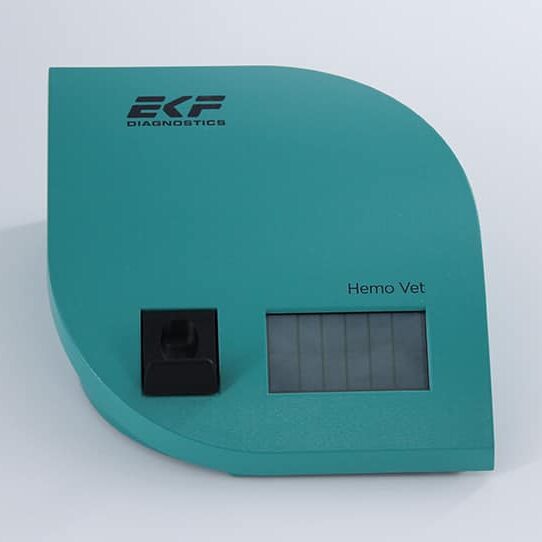
EKF Diagnostics Hemo Vet Blood Analyser
The Hemo Vet is a robust, simple and easy to use Haemoglobin and Haematocrit measurement device for veterinary medicine produced by EKF Diagnostics.
Hemo Vet uses the same photometric azide methemoglobin method as the Hemo Control does, ensuring reliable results with a high precision (CV <2%).
Hemo Control is used to evaluate various species and is reliable in a wide temperature range. The Hemo Vet analyser features a bi-directional interface using a public standard protocol that allows direct integration with third-party software.
EKF Diagnostics Hemo Vet use in research
The EKF Diagnostics Hemo Vet has been independently validated in dogs, showing strong agreement with automated haematology analysers for haemoglobin measurement (Pereira et al., 2014).
Dillane et al., 2018 used the Hemo Vet haemoglobin analyser to calculate haematocrit values in neonatal calves while establishing blood gas and biochemical reference ranges.
Another case report published in SCIENTIFIC WORKS SERIES C. VETERINARY MEDICINE Volume LXV (1), 2019 (page 70) Hemo Vet for quick Hb/Hct measurements in dogs and other species (Girdan et al., 2019).
Why Refractometers Remain Essential
Urine specific gravity (USG) remains one of the most valuable indicators of renal function and hydration status. It helps differentiate between pre-renal, renal and post-renal causes of azotaemia and is indispensable in diagnosing and monitoring kidney disease. While optical refractometers have been widely used for decades, digital refractometers offer greater consistency and eliminate the subjectivity involved in reading analogue scales.

The Atago PAL VET series provides fast, species-relevant USG readings with simple digital output. Models such as the PAL-DOG, PAL-CAT, PAL-RABBIT and PAL Dog & Cat are calibrated to typical urine ranges for companion animals, ensuring results are immediately interpretable. Their waterproof, handheld design means they’re practical in everyday consults as well as in cattery, kennel or field environments.
In day-to-day practice, digital refractometers help clinicians:
- Assess urine concentration accurately in cases of suspected renal disease
- Monitor hydration or diuresis in hospitalised patients
- Improve consistency across teams by reducing user-dependent variation
The Atago PAL Vet series use in research
Tvedten et al., 2014 compared an Atago PAL-USG Cat digital refractometer with a Schmidt & Haensch optical refractometer and reference solutions. The researchers found good overall correlation but a systematic tendency for the Atago unit to read slightly lower USG than the optical reference, which could affect interpretation near clinical cut-offs.
Yamamoto et al., 2019 looked at urinary creatinine/urea nitrogen ratios in dogs; they measured USG using Atago PAL-DOG&CAT.
The Growing Role of Lactate in Veterinary Medicine
Lactate has become an increasingly valuable biomarker in veterinary emergency and critical care, offering insight into tissue oxygenation and perfusion. Elevated lactate levels can indicate shock, severe dehydration or metabolic compromise. Even more importantly, changes in lactate over time can help predict prognosis and guide treatment decisions.

The EKF Diagnostics Lactate Scout Vet makes this kind of monitoring accessible at the point of care. Delivering results in around ten seconds from an extremely small sample volume, it allows veterinarians to assess perfusion status immediately during triage or ongoing stabilisation. With species settings for dogs, horses, cattle and pigs, and a robust, portable design, it suits both small animal clinics and large animal work.
Clinics can use lactate testing to:
- Evaluate the severity of shock or hypoperfusion
- Monitor response to fluid resuscitation or surgical intervention
- Support prognosis discussions with owners during critical cases

EKF Diagnostics Lactate Scout Vet
Introducing EKF Diagnostics’s Lactate Scout Vet, the ultimate tool for precise lactate level measurement in pets and livestock so you can make informed decisions for optimal care.
With user-friendly features and rapid results, it is ideal for veterinarians and animal welfare professionals.
Only 0.2 µl of capillary blood is required with results within 10 seconds, and can store up to 500 results.
Available to UK customers only.
Bringing It All Together in Everyday Practice
For many practices, the most effective diagnostic approach is not a large, complex lab, but a set of compact tools for veterinary clinics that deliver rapid, dependable information. The Hemo Vet, Atago PAL VET refractometers and Lactate Scout Vet each address different clinical needs. Together, they support faster decision-making, reduce reliance on external laboratories and help teams provide clearer, evidence-based guidance to clients.
When selecting point-of-care devices, considerations such as accuracy, ease of use, species applicability and ongoing consumable availability matter. Products designed specifically for veterinary use, such as those from EKF Diagnostics and Atago, offer the reassurance that results will be clinically meaningful and consistent.
By incorporating the right combination of in-house diagnostic tools, veterinary clinics can enhance patient care, improve workflow efficiency and elevate the standard of practice. HaB Direct can help guide the selection of these instruments to ensure they match each clinic’s caseload, objectives and budget.
Contact us today using the form below and one of our experts can assist you.
Contact Us
* indicates required fields


