

Biomechanics laboratories have long been essential environments for understanding human movement, injury mechanisms and performance optimisation. Traditionally, these laboratories relied on motion capture systems, force plates and instrumented treadmills to measure movement in controlled environments. While these technologies provide highly accurate data, they often assess movement in artificial conditions that differ significantly from real world environments. Recent advances in immersive technology are beginning to change this. Virtual reality environments now allow researchers and clinicians to simulate realistic scenarios while simultaneously capturing high precision biomechanical data. One example of this innovation is the Bertec Immersive Lab, an immersive biomechanics lab that allows researchers to study human movement within realistic environments while collecting high precision biomechanical data. It is a system designed to combine force measurement, motion analysis and virtual environments into a single research platform.
By integrating immersive environments with advanced biomechanical instrumentation, laboratories can now evaluate movement in settings that closely resemble real world conditions. This approach is opening new opportunities for research, rehabilitation and athletic performance analysis.
The Limitations of Traditional Biomechanics Laboratories
Biomechanics research has historically relied on controlled laboratory environments to ensure accurate measurements of movement. Motion capture cameras track joint angles, force plates measure ground reaction forces and instrumented treadmills assess walking or running mechanics. These tools remain fundamental in biomechanics research.
However, a common challenge in traditional laboratories is the lack of ecological validity. Participants are often asked to perform tasks in sterile environments that do not reflect the complexity of real world movement. Running in a blank laboratory space or walking on a treadmill while looking at a wall does not replicate the sensory inputs experienced outdoors or during sport.
These differences can influence movement behaviour. Visual cues, terrain variation and environmental distractions all affect how individuals move. Without these elements, gait patterns and movement strategies may differ from those used in real world situations.
Virtual reality technology addresses this challenge by allowing researchers to recreate realistic environments while maintaining precise measurement capabilities.
What Is an Immersive Biomechanics Laboratory?
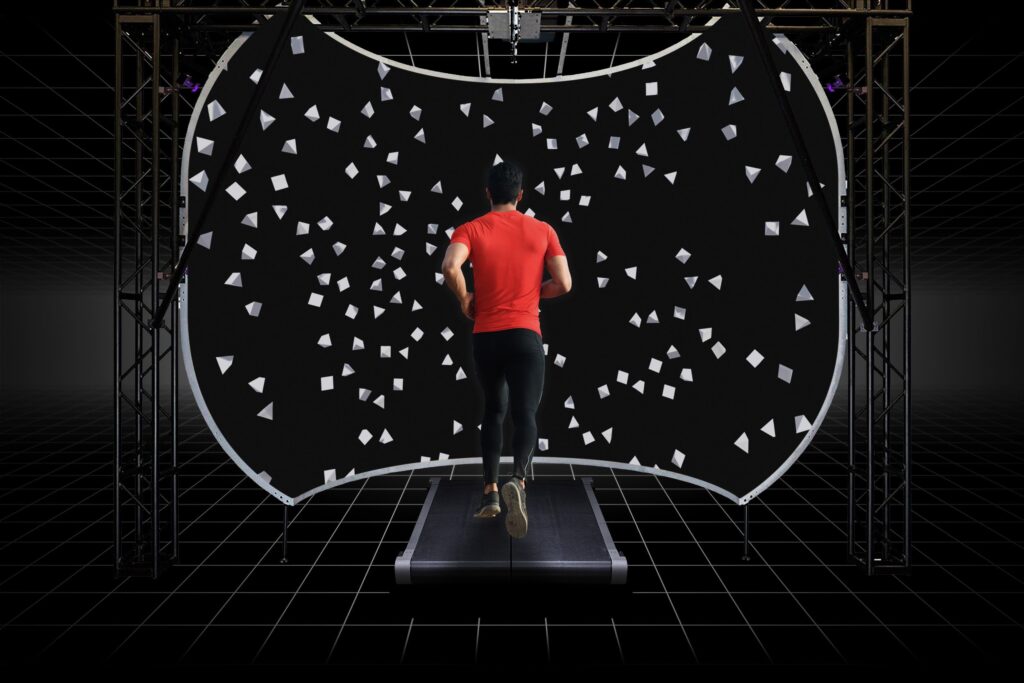
An immersive biomechanics laboratory combines traditional motion analysis tools with a fully integrated virtual environment. Participants move within a simulated environment that responds dynamically to their actions, while sensors capture detailed biomechanical data.
The Bertec Immersive Lab is designed specifically for this purpose. The system typically includes:
- A dual belt instrumented treadmill with integrated force plates
- High resolution motion capture integration
- A curved projection screen or immersive display environment
- Real time motion tracking and synchronised data collection
- Software capable of creating interactive virtual environments
This setup allows researchers to study movement while participants interact with simulated environments such as city streets, running tracks, trails or sports settings. Obstacles, slopes and environmental cues can be introduced to replicate real world challenges.
Because biomechanical data and virtual environments are synchronised, researchers can observe how individuals respond to changing conditions while collecting accurate force and motion data.

Bertec Immersive Lab with FIT Gen 5 Treadmill
Bertec Immersive Labs is an integrated research system for biomechanical analysis. It combines a force-instrumented split-running belt (dual belt) treadmill, a 3D motion capture system, and a virtual reality (VR) dome.
To be paired with the Bertec Treadmill Fit Gen 5.
Applications of the Immersive Biomechanics Lab in Sports Science
One of the most exciting uses of immersive biomechanics laboratories is within sports science. Athletes must often make rapid decisions while moving at high speed, responding to opponents, terrain changes and visual stimuli.
Traditional testing environments cannot easily recreate these scenarios. In an immersive biomechanics lab, researchers can recreate real world movement scenarios while capturing ground reaction forces, muscle activity and joint kinematics
For example, a runner can be placed in a virtual road race environment while their ground reaction forces, stride mechanics and joint loading patterns are analysed. Researchers can introduce visual distractions, changes in terrain or pacing challenges to evaluate how these factors influence biomechanics.
This type of testing can provide valuable insights into injury risk, fatigue responses and technique changes under pressure. Coaches and performance specialists can then use this information to refine training programmes and improve performance outcomes.
Advancing Clinical Rehabilitation
Immersive laboratories are also becoming increasingly valuable in clinical rehabilitation settings. Patients recovering from neurological or musculoskeletal injuries often require structured gait retraining and balance rehabilitation.
Traditional treadmill rehabilitation can sometimes feel repetitive or disengaging for patients. Virtual environments introduce interactive elements that can improve engagement and motivation during therapy sessions.
For example, a patient recovering from stroke may practise walking within a simulated environment that encourages obstacle avoidance or directional changes. These tasks can help retrain coordination, balance and spatial awareness.
Research has shown that virtual reality based gait training can improve motor learning and reduce fall risk in neurological populations. Mirelman et al. (2016) demonstrated that virtual reality gait training can enhance walking ability and reduce fall risk in individuals with Parkinson’s disease by promoting motor learning in complex walking tasks.
Source: https://academic.oup.com/biomedgerontology/article/71/9/1197/2605493
By combining real time biomechanical measurements with immersive training environments, clinicians can monitor patient progress while delivering more engaging rehabilitation sessions.
Improving Balance and Fall Prevention Research
Balance disorders and fall risk are major concerns for ageing populations and neurological patients. Understanding how individuals respond to environmental challenges is critical when developing effective fall prevention strategies.
Immersive laboratories allow researchers to simulate real world situations that might contribute to falls, such as uneven terrain, obstacles or crowded environments. Participants can be safely exposed to these scenarios while researchers analyse balance responses and movement adaptations.
Studies have shown that virtual environments can influence gait and balance behaviour by introducing visual and sensory cues that more closely resemble real world conditions. Raffegeau et al. (2020) highlighted how immersive environments can be used to investigate gait stability and balance control in controlled research settings.
Source: https://www.frontiersin.org/articles/10.3389/fbioe.2020.00424
This approach allows researchers to better understand how people respond to environmental challenges and develop targeted interventions to reduce fall risk.
Integrating Wearable Biomechanics Sensors for Deeper Movement Analysis
While immersive biomechanics lab environments allow researchers to recreate realistic scenarios for movement analysis, wearable sensor technology adds another layer of insight by capturing detailed information about muscle activation and body segment motion.
Systems such as the Noraxon Ultium EMG and Noraxon Ultium Motion can be integrated into immersive biomechanics testing environments to provide a comprehensive view of human movement.
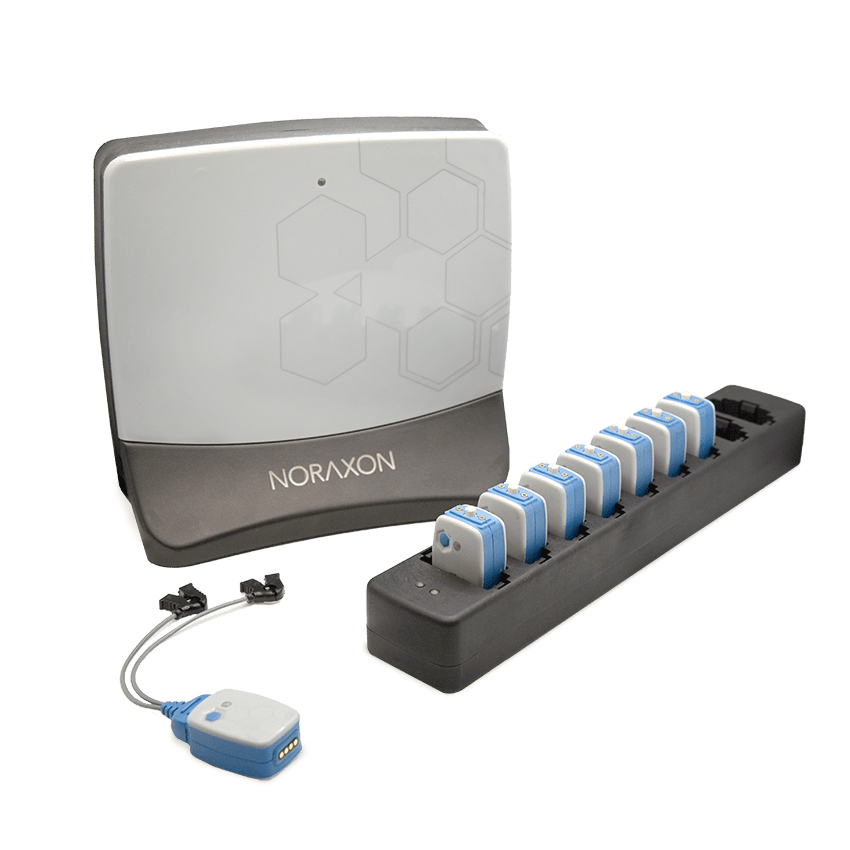
Noraxon Ultium Wireless Surface EMG
The Noraxon Ultium Wireless Surface EMG is a research-grade Wireless EMG system equipped with high sampling rate & resolution, low baseline noise, versatile SmartLead options, and powerful wireless communication.
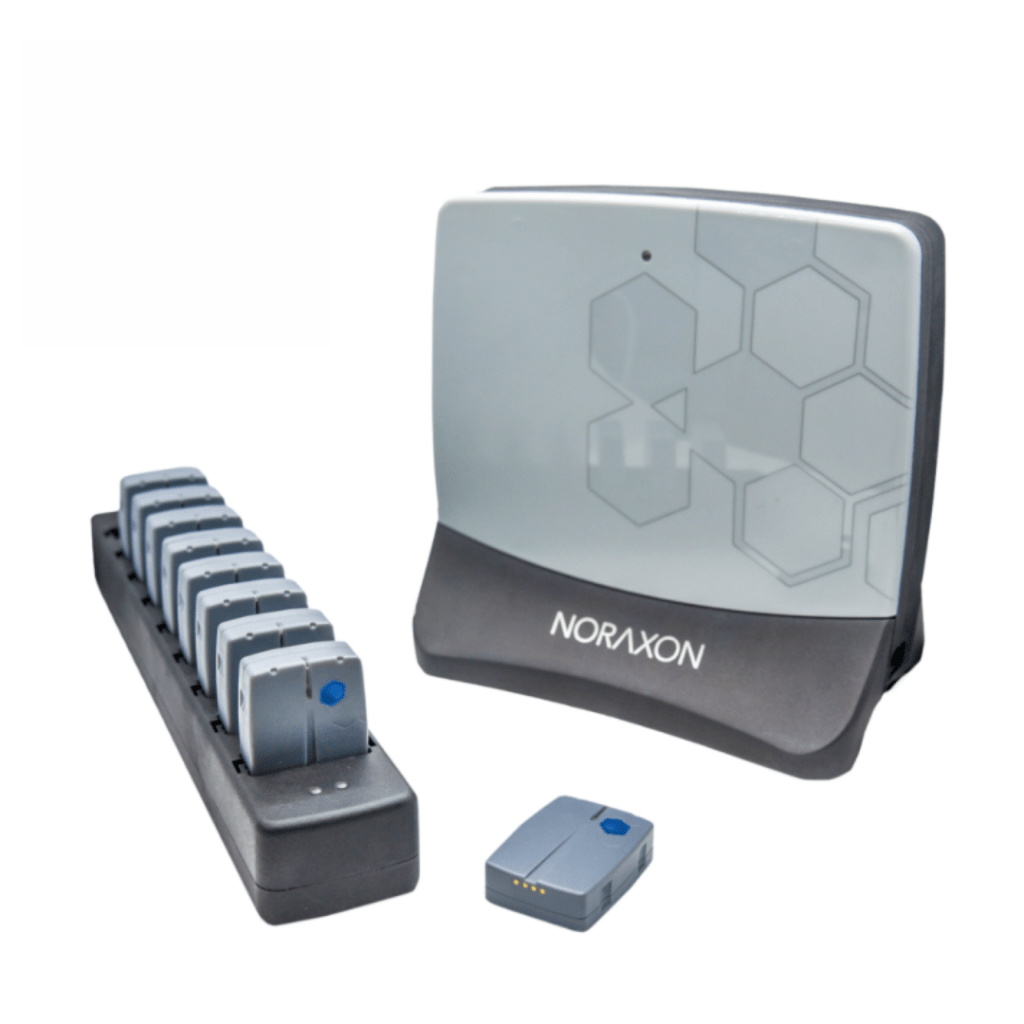
Noraxon Ultium Motion 3D Motion Capture/IMU System
The Noraxon Ulltium Motion 3D Capture System uses an array of inertial measurement units (IMUs) to measure anatomical joint angles, orientation angles, and linear acceleration in natural and lab-based environments.
Electromyography sensors measure muscle activation patterns during movement, allowing researchers and clinicians to see when specific muscles are engaged and how strongly they are firing during tasks such as walking, running or jumping. In rehabilitation settings, EMG data can reveal neuromuscular deficits, delayed muscle activation or compensatory movement patterns that may contribute to injury risk or delayed recovery.
Inertial measurement units provide detailed kinematic information by tracking the orientation, acceleration and rotation of body segments. When placed on key anatomical landmarks, these sensors allow researchers to reconstruct full body movement patterns without relying solely on camera based motion capture systems.
When combined with immersive environments, these technologies enable researchers to investigate how both movement mechanics and neuromuscular control change in realistic scenarios.
Synchronising Biomechanics Data with Noraxon MR4 Software
To fully benefit from integrating immersive environments with wearable sensors, laboratories must also ensure that all biomechanical data streams are synchronised and analysed within a single platform. This is where Noraxon MR4 plays an important role.
MR4 is Noraxon’s unified biomechanics software platform, designed to collect, synchronise and analyse data from multiple sensor systems. When used alongside the Noraxon Ultium EMG and Noraxon Ultium Motion, MR4 allows researchers to capture muscle activity, body segment motion and other physiological data within a single analysis environment.

During testing in the Bertec Immersive Lab, researchers can simultaneously record ground reaction forces, joint kinematics and muscle activation patterns while the participant interacts with the simulated environment. MR4 synchronises these signals in real time, allowing detailed analysis of how neuromuscular control, movement mechanics and external forces interact.
For example, a running biomechanics study may combine:
- Ground reaction force data from the instrumented treadmill
- Segmental kinematics from wearable IMU sensors
- Muscle activation patterns measured with EMG
- Environmental interactions from the immersive virtual scenario
By aligning these datasets, researchers can gain a deeper understanding of how the nervous system and musculoskeletal system interact during complex movement tasks.
The Future of Biomechanics Research
Immersive technology is rapidly expanding the possibilities for movement science. As virtual environments become more sophisticated, researchers will be able to simulate increasingly complex scenarios that mirror real world environments.
Future developments may include sport specific immersive simulations, integration with cognitive testing tools, artificial intelligence driven environmental adaptations and remote rehabilitation environments. The immersive biomechanics lab represents the next generation of movement science laboratories.
These advances will continue to blur the boundaries between laboratory research and real world movement analysis.
Supporting Immersive Lab Installations in the UK
As immersive biomechanics laboratories become more common in research and clinical environments, expert installation and support are essential to ensure these complex systems operate effectively.
As the UK distributor for Bertec, HaB Direct works with universities, sports science laboratories and clinical facilities to deliver advanced biomechanical testing solutions. From consultation and system design to installation and training, HaB Direct supports laboratories looking to integrate immersive technologies into their research and rehabilitation environments.


