

With the European Athletics Championships having taken place in Birmingham from 10 to 16 August 2026, attention has turned to the speed, strength and technical precision required across the long jump, triple jump, high jump and pole vault.
Although these events look very different, every successful jump depends on how effectively an athlete produces, controls and redirects force. The final distance or height provides the result, but it does not explain how the athlete achieved it. For coaches, sports scientists and researchers, force plate jump analysis can reveal what happens during the brief but decisive moments when the athlete interacts with the ground.
The Noraxon Vector Force Plates provide portable measurement of vertical ground reaction forces during jump, landing and strength assessments. When used within a consistent testing protocol, they can help practitioners examine force production, impulse, contact time, rate of force development and inter-limb differences, producing information that cannot be obtained from jump height alone.

What Is Jump Analysis and Why Is It Important?
A jump is the result of several linked phases. In athletics, these may include an approach, take-off, flight and landing. Each phase influences the next, and a small change in speed, timing, posture or force application can affect the final performance.
The technical demands also vary by event. A long jumper must retain approach speed while generating sufficient vertical impulse at the board. A triple jumper must manage three consecutive contacts while preserving horizontal momentum. A high jumper redirects approach speed upwards and rotates the body to clear the bar. A pole vaulter transfers energy from the approach into the pole before converting it into vertical displacement.
The movements are visually spectacular, but many of the most important actions occur too quickly to assess accurately by eye. Biomechanical testing gives practitioners objective data that can be compared across trials, training blocks and stages of rehabilitation.
Understanding Ground Reaction Force
Whenever an athlete pushes against the ground, the ground applies an equal and opposite force to the athlete. This is known as ground reaction force. Its magnitude and timing influence how the athlete accelerates, takes off and absorbs load on landing.
Force plates record this interaction over time. Instead of reporting only the outcome of a jump, such as height or distance, they produce a force-time curve showing how force changed throughout the movement.
The Noraxon Vector Force Plates are portable, single-axis platforms designed for jump analysis, performance testing, training, research and applied movement assessment. They can quantify vertical loading and force production, but they do not independently measure the anterior-posterior forces associated with braking and propulsion or the mediolateral forces associated with side-to-side loading. Where a project requires three-dimensional force measurement, practitioners should select an appropriate multi-axis system.
For many routine jump assessments, however, vertical force data can provide valuable insight into lower-body performance, loading strategies and movement symmetry.

What Can Noraxon Vector Force Plates Measure?
The metrics selected will depend on the jump, research question and testing protocol. Common measures include the following.
Peak force
Peak force is the highest force recorded during a selected phase of the movement. It can help describe an athlete’s maximum force production during take-off or the maximum load experienced during landing. However, peak force should not be interpreted alone because it does not show how quickly the force was produced or how long it was applied.
Impulse
Impulse is calculated from force applied over time. In practical terms, it helps explain how the athlete changes their momentum. During a vertical jump, the net impulse generated before take-off contributes to take-off velocity and therefore jump height.
This is one reason two athletes can reach a similar jump height using different strategies. One may produce a large force over a shorter period, while another applies force for longer. Examining the full force-time curve gives more context than the final height alone.
Rate of force development
Rate of force development describes how rapidly force rises. This can be relevant in explosive sporting actions where the athlete has limited time to produce force. In jumping events, the available contact time at take-off may be very short, making rapid force production an important quality.
Rate-of-force-development results can be sensitive to calculation choices, sampling windows and movement onset definitions. Testing and analysis methods therefore need to remain consistent if results are to be compared meaningfully.
Contact time
Contact time records how long the athlete remains in contact with the force plate during a movement. It is particularly useful in drop jumps and repeated hopping tasks, where practitioners may be interested in how quickly an athlete moves from landing into take-off.
Contact time should always be interpreted in relation to the task. A shorter contact is not automatically better if it is accompanied by lower force production, reduced jump height or poor landing control.
Jump height
Jump height can be estimated from force plate data using methods based on take-off velocity or flight time. The chosen calculation method matters. A systematic review by Eythorsdottir et al. (2024) found that differences in equations and methodological choices can influence force-platform estimates of jump height. Consistent protocols and calculation methods are therefore essential when tracking change over time.
Left-to-right differences
When two plates are used together, practitioners can compare the contribution of each limb during bilateral tasks. Separate plates can also support unilateral jump and landing assessments.
These comparisons may identify a difference in force production, impulse or landing load between the left and right sides. However, asymmetry is not automatically evidence of injury, and a single symmetry percentage cannot describe the athlete’s entire movement strategy. Results should be interpreted alongside the athlete’s history, event demands and other biomechanical information.
Jump Tests Used in Performance and Rehabilitation
Laboratory-based jump analysis cannot always recreate every element of an elite athletics event. Instead, practitioners often use standardised tests that isolate qualities related to explosive performance and landing control.
Countermovement jump
The countermovement jump begins with a rapid downward movement followed by an immediate upward action. It uses the stretch-shortening cycle and is widely employed to assess lower-body neuromuscular performance.
A force plate can divide the movement into phases and examine variables including braking impulse, propulsive impulse, peak force, take-off velocity and jump height. This allows practitioners to see whether a change in performance came from greater force production, a longer movement time or a different strategy.
Squat jump
The squat jump starts from a stationary flexed position and removes the initial countermovement. Comparing squat-jump and countermovement-jump results can provide information about how an athlete uses the preceding downward movement, although the comparison must be conducted using carefully controlled techniques.
Countermovement and squat jumps are both established tests of lower-limb performance, but they assess related rather than identical qualities (Petrigna et al., 2019).
Drop jump
During a drop jump, the athlete steps from a predetermined height, lands and then jumps vertically as quickly as possible. Force plates can measure landing forces, ground contact time and the subsequent take-off.
This is commonly used to examine reactive strength and stretch-shortening-cycle function. Drop height, footwear, surface and instructions can all affect the results, so these conditions should be standardised.
Single-leg jumping and landing
Unilateral tests can reveal performance strategies that are less visible during bilateral tasks. They may be used in athlete profiling or rehabilitation to compare limbs and assess how an athlete produces and absorbs force.
Research has shown that vertical jump tasks can reveal persistent performance and biomechanical differences following anterior cruciate ligament reconstruction, even when other functional tests appear symmetrical (Kotsifaki et al., 2022). Force plate results should nevertheless form part of a broader clinical assessment rather than determine return-to-sport decisions alone.
From Take-Off to Landing
Force production during take-off often receives the greatest attention because it influences the athlete’s movement into the air. Landing deserves equal consideration, particularly in events involving repeated contacts.
Triple jump is a clear example. The athlete must manage the hop, step and jump while maintaining performance and tolerating substantial loading. Research by Perttunen et al. (2000) reported the greatest ground reaction forces during the step phase in the athletes studied, illustrating the exceptional loads that can occur during the event.
In controlled testing, force plates can help practitioners examine how an athlete absorbs force on landing. Useful measures may include peak landing force, loading rate, time to stabilisation and left-to-right distribution. These results can inform further investigation of landing techniques and help practitioners monitor changes during training or rehabilitation.
It is important not to use force plate data as a simple injury-prediction score. Movement patterns are influenced by task instructions, fatigue, strength, previous injury and many other factors. Biomechanical information is most useful when it helps practitioners ask better questions and track an individual athlete over time.
Why Testing Protocols Must Be Consistent
Force plate data is only useful when the testing procedure is sufficiently repeatable. Changes in warm-up, arm position, jump depth, footwear, surface, instructions or calculation methods can alter the results.
Before testing, practitioners should define:
- The jump or landing task
- The athlete’s arm position
- Whether jump depth is self-selected or controlled
- The number of practice and recorded trials
- Rest time between trials
- The variables and calculation methods being used
- How an acceptable trial will be identified
The athlete should understand the instructions and practise the movement before data is recorded. Comparing an athlete with their own established baseline can often be more informative than applying a general reference value without considering their event, level and testing history.
Research also shows that not every force plate metric has the same reliability. Merrigan et al. (2024), for example, found differences in reliability across countermovement-jump variables and force plate systems. Selecting appropriate measures and using the same procedures and equipment are therefore central to meaningful longitudinal monitoring.
Combining Force with Motion and Muscle Activity
Vertical force data answers an important question: how did the athlete apply force to the ground? It does not independently explain the joint positions or muscular actions that produced that force.
The Noraxon ecosystem allows force measurements to be integrated with other technologies within MR software. Depending on the laboratory and research question, Vector Force Plates can be combined with:
- Noraxon Ultium Motion to examine joint movement and segment orientation
- Noraxon Ultium EMG to investigate the timing and intensity of muscle activation
- Noraxon video systems to provide synchronised visual context
Combining these signals can produce a more complete analysis. A practitioner might identify a left-to-right difference in landing force, then use motion data to examine lower-limb movement and EMG to explore muscle activation during the same trial.
The measurements remain distinct, but synchronisation makes it easier to understand how they relate to one another.
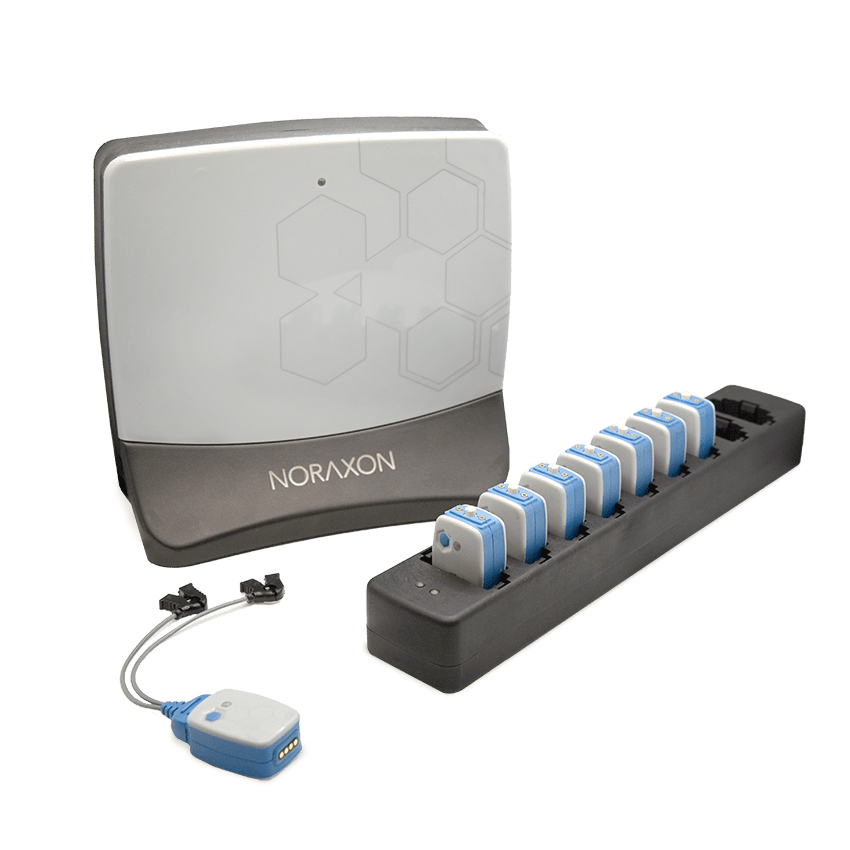
Noraxon Ultium Wireless Surface EMG
The Noraxon Ultium Wireless Surface EMG is a research-grade Wireless EMG system equipped with high sampling rate & resolution, low baseline noise, versatile SmartLead options, and powerful wireless communication.
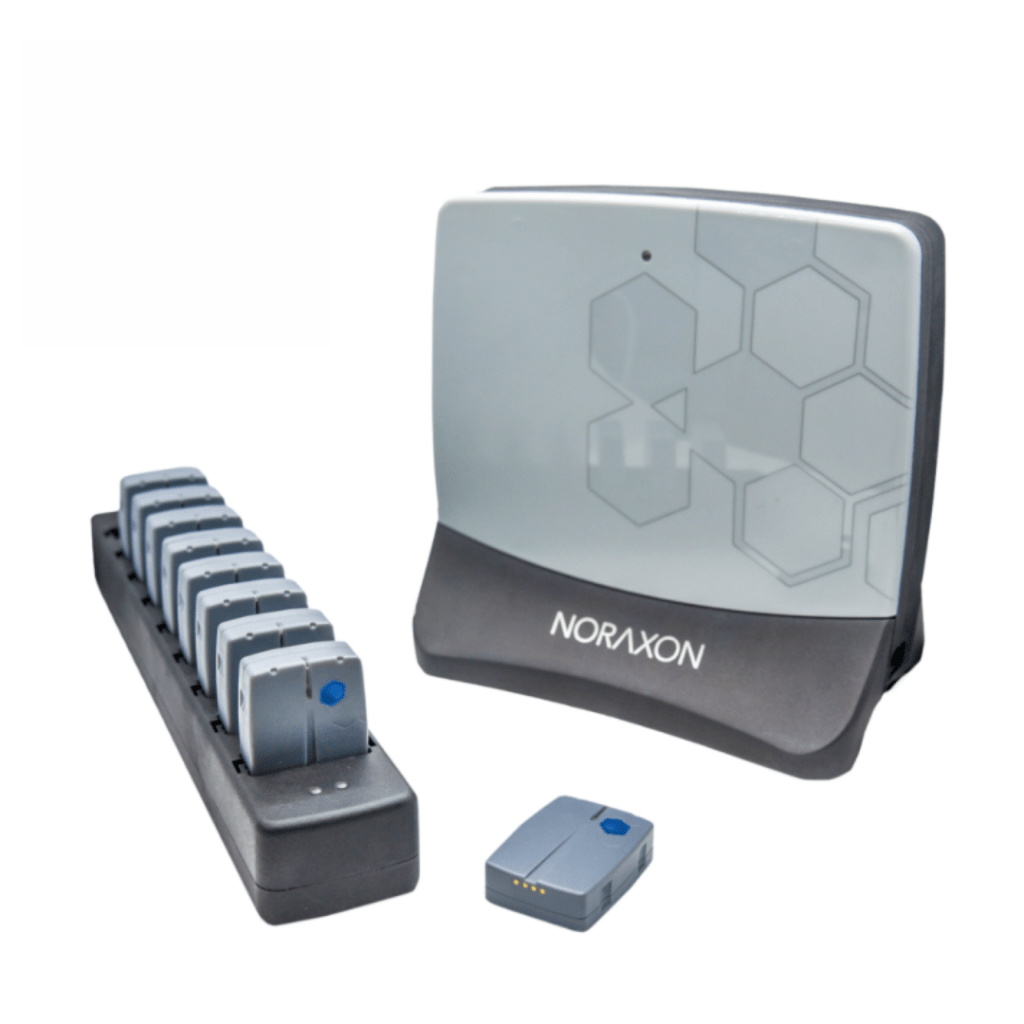
Noraxon Ultium Motion 3D Motion Capture/IMU System
The Noraxon Ulltium Motion 3D Capture System uses an array of inertial measurement units (IMUs) to measure anatomical joint angles, orientation angles, and linear acceleration in natural and lab-based environments.
Noraxon Vector Force Plates
The Noraxon Vector Force Plates are portable, single-axis platforms designed for performance testing, training, research and applied jump and movement analysis. They capture vertical ground reaction force at a sample rate of 1,000 Hz with 16-bit resolution and connect through USB for power and data.
Each plate measures 61 × 61 × 6 cm and weighs approximately 14 kg. The total measurement range is 11,768 N, with 2,942 N per sensor. Integration with Noraxon MR software supports force capture, jump analysis and automated reporting within a streamlined workflow.
The system can be used for:
- Countermovement and squat jumps
- Unilateral jump and landing tests
- Strength assessments
- Balance-related tasks
- Performance monitoring
- Rehabilitation and return-to-activity assessment
Portability also allows the plates to be used in different testing environments without requiring a permanently installed laboratory floor. As with any force plate system, placement, calibration, protocol design and analyst expertise remain essential to data quality.
Turning Jump Analysis Data into Better Questions
Force plates do not tell a coach exactly how an athlete should train, nor can one test predict how far or high an athlete will jump in competition. Their value lies in making an athlete’s interaction with the ground measurable.
By examining force, impulse, contact time, rate of force development and limb contribution, practitioners can look beyond the final jump result. Repeated testing can show whether performance has changed, while integrated motion and EMG measurements can help investigate the strategy behind that change.
As Europe’s leading athletes prepare to compete in Birmingham, the jumping events will demonstrate how speed, strength and technique come together within fractions of a second. Noraxon Vector Force Plates give sports scientists, coaches and researchers a way to study those decisive moments, from take-off to landing.
HaB Direct supplies Noraxon biomechanics technology throughout the UK and Ireland, with specialist support available for system selection, integration, training and after-sales service.
Find out more about Noraxon Vector Force Plates or contact the HaB Direct team to discuss your jump-testing and biomechanics requirements.
References
European Athletics (2026) European Athletics Championships overview. Available at: https://www.european-athletics.com/home/competitions/european-athletics-championships/overview
Eythorsdottir, I., Gløersen, Ø., Rice, H., Werkhausen, A., Ettema, G., Mentzoni, F., Solberg, P., Lindberg, K. and Paulsen, G. (2024) ‘The battle of the equations: A systematic review of jump height calculations using force platforms’, Sports Medicine, 54, pp. 2771–2791. Available at: https://doi.org/10.1007/s40279-024-02098-x
Kotsifaki, A., Van Rossom, S., Whiteley, R. et al. (2022) ‘Single leg vertical jump performance identifies knee function deficits at return to sport after ACL reconstruction in male athletes’, British Journal of Sports Medicine, 56(9), pp. 490–498. Available at: https://doi.org/10.1136/bjsports-2021-104692
Merrigan, J.J., Strang, A., Eckerle, J. et al. (2024) ‘Countermovement jump force-time curve analyses: Reliability and comparability across force plate systems’, Journal of Strength and Conditioning Research, 38(1), pp. 30–37. Available at: https://doi.org/10.1519/JSC.0000000000004586
Noraxon (2026) Vector Force Plates: Vertical force testing with Noraxon. Available at: https://www.noraxon.com/our-products/vector-force-plates/
Perttunen, J.O., Kyröläinen, H., Komi, P.V. and Heinonen, A. (2000) ‘Biomechanical loading in the triple jump’, Journal of Sports Sciences, 18(5), pp. 363–370. Available at: https://pubmed.ncbi.nlm.nih.gov/10855682/
Petrigna, L., Karsten, B., Marcolin, G., Paoli, A., D’Antona, G., Palma, A. and Bianco, A. (2019) ‘A review of countermovement and squat jump testing methods in the context of public health examination in adolescence: Reliability and feasibility of current testing procedures’, Frontiers in Physiology, 10, 1384. Available at: https://pmc.ncbi.nlm.nih.gov/articles/PMC6853898/


