
Throwing performance is shaped by far more than the strength of an athlete’s arm. In the javelin, discus, shot put and hammer, the distance achieved depends on how the athlete produces force, coordinates movement and releases the implement.

Release velocity is one of the strongest determinants of throwing distance, but release angle, release height, implement orientation and aerodynamics can also affect the result. Biomechanics helps coaches and researchers examine these factors and understand how the athlete’s technique contributes to them.
Central to this process is the kinetic chain. Force and momentum develop through the athlete’s interaction with the ground before the lower body, pelvis, trunk and upper limbs contribute to the movement. When these actions coordinate effectively, more energy can be directed into the implementation. When their timing or positioning is disrupted, velocity may be lost and other parts of the body may have to compensate.
Although this principle applies to every throwing event, it appears differently in the javelin, discus, shot put and hammer.
The kinetic chain and throwing performance
The kinetic chain describes how body segments work together during movement. In throwing, this should not be imagined as a perfectly simple relay in which force passes unchanged from one joint to the next. The athlete produces, transfers, absorbs and redirects mechanical energy throughout the movement.
The process starts with ground contact. As the athlete applies force to the ground, the ground applies an equal and opposite force to the athlete. These ground reaction forces help accelerate, support and reposition the body. The lower limbs and hips then contribute to translation, rotation or both, while the trunk provides a mobile but stable connection between the lower and upper body. Finally, the shoulder, elbow, wrist and hand help accelerate and direct the implement towards release.
Release velocity is particularly important because it is strongly associated with throwing distance. However, release angle, release height, implement orientation and aerodynamics also influence the result, with their relative importance varying between events (Łysoń-Uklańska et al., 2021).
Javelin: converting the approach into release velocity

Of the four events, the javelin most clearly combines linear speed with an overhead throwing action. The run-up gives the athlete forward momentum. During the withdrawal and crossover steps, the athlete positions the javelin and prepares the body for the delivery phase without losing control of that momentum.
As the front foot lands, the lead leg creates a firm base from which the body can redirect forward motion. This is often called the block. Rather than simply stopping the athlete, an effective block helps convert whole-body momentum into trunk movement and, ultimately, javelin velocity. Research has highlighted the importance of front-leg stability and the contribution of the lower limbs, trunk and shoulder to the implement’s forward and upward velocity (Makino et al., 2023).
The pelvis begins to move ahead of the upper trunk, creating separation between the hips and shoulders. The trunk then rotates and moves forwards before the throwing shoulder internally rotates and the elbow extends. Studies of elite throwers have observed a proximal-to-distal pattern in which peak velocity occurs first closer to the body and later in the arm. Therefore allowing the hand and javelin to reach the greatest speed near release (Łysoń-Uklańska et al., 2021).
If the front knee collapses excessively, the trunk opens too early or the arm accelerates before the lower body and trunk have contributed, energy may be absorbed or redirected inefficiently. The athlete may then try to create speed primarily at the shoulder and elbow, potentially reducing performance and increasing local loading.
Discus: building speed through rotation

The discus replaces the javelin’s straight run-up with rotation across the throwing circle. The athlete uses alternating double- and single-support phases to build angular momentum while remaining balanced enough to enter an effective delivery position.
Force applied against the ground drives the movement of the lower body. The legs and hips accelerate and reposition the athlete, while separation between the pelvis and shoulders allows the trunk and throwing arm to follow. During the delivery, the lead side provides a stable base, the hips and trunk rotate, and the throwing arm travels through a long path before release.
This sequencing matters. If the shoulders turn before the lower body has established the throw, the athlete may lose the stretch and timing created between the pelvis and upper trunk. If foot contact is poorly controlled, rotational speed may not be directed effectively into the discus. Research has found relationships between discus performance and both ground reaction force variables and the organisation of the hips and shoulder line (Łysoń-Uklańska et al., 2021).
The final hand action contributes to the discus’s speed, orientation and spin, but it works best when supported by the motion already generated through the legs, hips and trunk. Release velocity remains a major determinant of distance, while release angle, attitude angle and aerodynamic conditions influence the subsequent flight.
Shotput: accelerating a heavy implement over a short path

The shotput demands high force and power because the athlete must accelerate a relatively heavy implement within the limited space of the circle. Although glide and rotational techniques use different routes into the power position, both rely on coordinated action throughout the body.
In the glide, the athlete drives across the circle and establishes the feet beneath the body before the delivery. With the rotational technique, angular momentum is developed through a turn resembling elements of the discus throw. In both cases, the lower body creates and redirects momentum, the legs and hips extend and rotate, and the trunk contributes to the upward and forward acceleration of the shot.
During the final delivery, the blocking side stabilises while the throwing side continues to rotate and extend. The shoulder and elbow then complete a pushing action, with the shot remaining close to the neck until release. Mechanical-energy analysis has shown that the trunk and lower limbs play substantial roles in the shotput’s acceleration. Thus confirming that successful putting is a whole-body action rather than an isolated arm movement (Błażkiewicz et al., 2016).
An athlete can be exceptionally strong but still lose release velocity if the feet arrive late, the hips and shoulders rotate together without effective separation, or force is directed away from the intended release path. This is why technique and strength must be assessed together.
Hammer throw: repeated interaction between athlete, ground and implement

The hammer throw presents a different version of the kinetic chain. The athlete and implement form a linked rotating system, and the thrower must continually manage the large force exerted through the cable while accelerating the hammer through a series of turns.
During each turn, the athlete alternates between single- and double-support phases. Ground reaction forces, body position and cable tension interact as the athlete counterbalances the implement and changes its speed and direction. The legs do not simply initiate one upward chain of movement. They repeatedly apply and receive force, control the athlete’s centre of mass and help maintain an effective relationship with the hammer’s orbit.
The lower body and pelvis lead changes in position, while the trunk and arms connect the athlete to the implement. The arms are generally kept long so that the hammer can travel on a large radius, but they must remain supported by the posture and movement of the rest of the body. The athlete aims to increase hammer speed across the turns while arriving at release with the correct balance, direction and orbit.
A review of hammer biomechanics identifies release velocity as a central performance factor and highlights the importance of the hammer’s orbit, support phases, cable force and the coordinated motion of the thrower-hammer system (Castaldi et al., 2022). Because force changes rapidly throughout each turn, a single video angle or isolated strength score may miss the cause of a technical problem.
How is throwing biomechanics measured?
Visual observation remains valuable, but the speed and complexity of throwing make some events difficult to judge by eye. Combining measurement technologies can reveal not only what happened, but also when it happened and how different parts of the movement were related.
Noraxon Ultium EMG
Noraxon Ultium EMG records muscle activation during movement. In throwing analysis, surface EMG can help researchers investigate when selected muscles become active, how activation patterns differ between limbs and whether muscles are working together to produce or stabilise movement.
For example, EMG may be used to examine lower-limb activation around foot contact, trunk muscle activity during rotation or the timing of shoulder and arm muscles during delivery. The results must be interpreted carefully, as surface EMG measures electrical activity rather than force directly, but it can add an important layer to kinetic and kinematic data.
Noraxon Ultium Motion
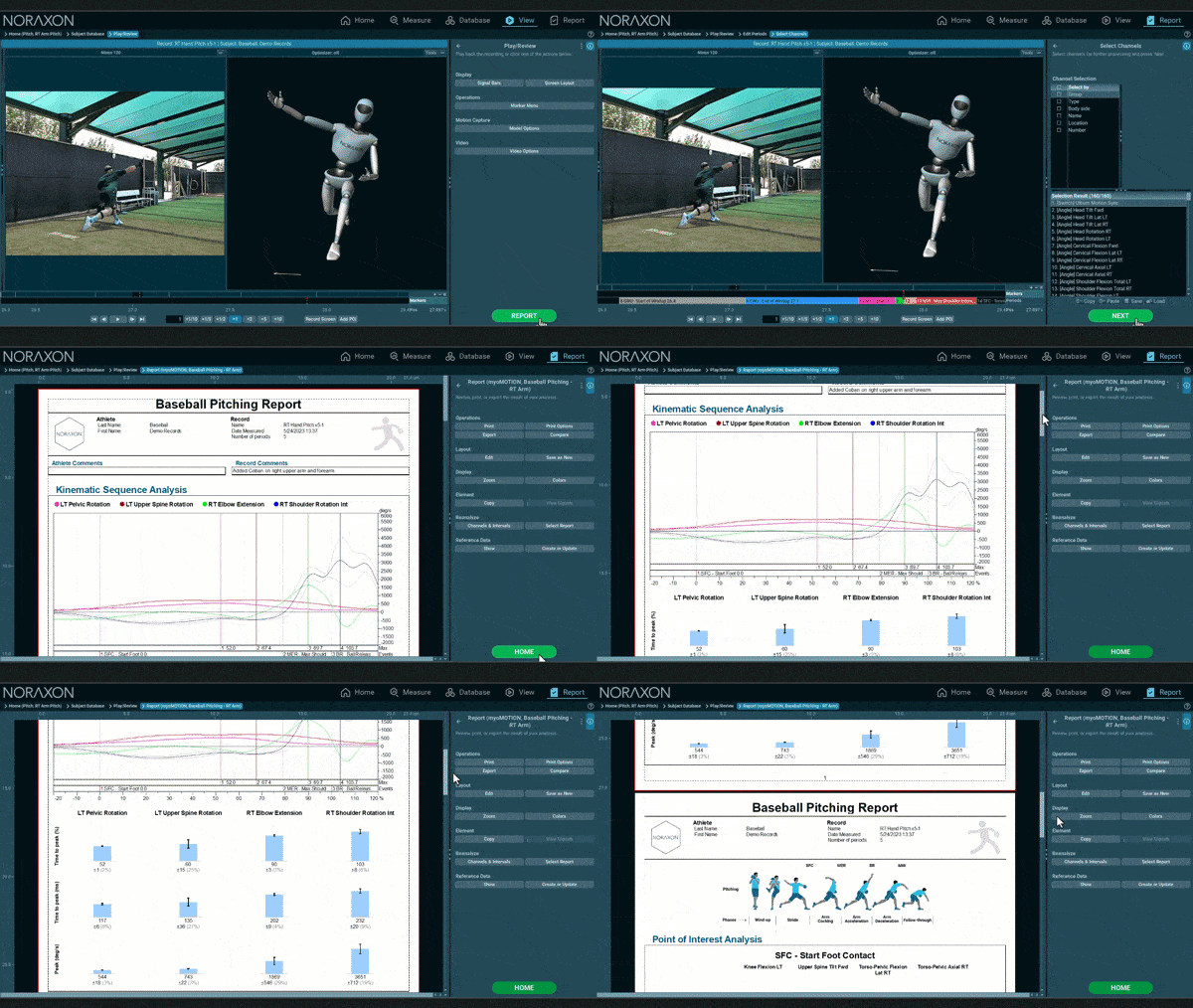
Noraxon Ultium Motion uses wearable inertial sensors to capture 3D kinematics, including segment orientation, joint motion, acceleration and angular velocity. Its wireless design allows athletes to perform dynamic movements without being restricted to a small optical capture area.
In throwing events, this can help quantify pelvis and trunk rotation, hip-to-shoulder separation, joint angles and the order in which segments reach peak angular velocity. Comparing successful and unsuccessful attempts can reveal whether an apparent arm problem began earlier in the chain.
Force plates
Force plates measure the forces and moments produced as the athlete interacts with the ground. Depending on the set-up, they can help identify the magnitude, direction and timing of ground reaction forces, loading between limbs and changes across support phases.
These measurements can be especially useful when examining the javelin block, the power position in shot put, force production during the discus delivery or the changing demand of hammer turns. The Noraxon Vector Force Plates can also be synchronised with other data in Noraxon MR software, making it possible to relate ground contact to muscle activity and body position.
High-speed video
High-speed video makes rapid technical events visible frame by frame. It can be used to review foot contacts, delivery positions, release timing, implement orientation and the relationship between the athlete and implement.
Video is particularly valuable for communicating findings to athletes and coaches. When synchronised with EMG, motion capture or force data, the footage provides visual context for peaks and changes that might otherwise appear only as lines on a graph.
Strength-testing equipment
Strength testing helps establish whether the athlete has the physical capacity to execute the positions identified in the biomechanical assessment. Isometric and dynamic testing can examine qualities such as lower-body force, rate of force development, trunk strength, shoulder rotation strength and differences between sides.
The aim is not simply to find the strongest thrower. Testing should relate to the demands of the event and the individual athlete’s technique. A javelin thrower who cannot maintain a stable lead leg, for example, may require a different intervention from a discus thrower whose main limitation is the timing of pelvic rotation. Repeated testing can then show whether changes in physical capacity are transferring into the throwing action.
Why synchronised data matters:
- Each technology answers a different question:
- Force plates show how the athlete interacts with the ground.
- Motion capture shows how the body segments move.
- EMG shows when selected muscles are active.
- High-speed video provides visual evidence of technique and release.
- Strength testing assesses the physical capacity that supports the movement.
Viewed separately, these measurements provide useful information. When synchronised, they give a more complete picture of the kinetic chain. A researcher might identify a force peak beneath the lead foot, see the corresponding pelvis and trunk positions, examine muscle activation around that instant and review the exact frame of the throw. This makes it easier to distinguish a strength limitation from a timing, coordination or positioning issue.
Turning biomechanical insight into throwing performance
There is no single ideal kinetic-chain pattern that can be copied across every athlete or event. Technique is influenced by the implement, the rules of the event, the athlete’s physical characteristics and whether they use a glide, rotational or other technical variation.
The purpose of biomechanical analysis is therefore not to reduce a throw to one number. It is to identify where throwing performance is being created, where energy may be lost and which change is most likely to help the individual athlete.
Biomechanics influences throwing performance by determining how effectively an athlete produces force, coordinates the body and directs energy into the implement. Release velocity may be the clearest outcome, but it is created by a complex interaction between ground reaction forces, segment movements, muscle activity, technique and physical capacity.
By combining EMG, motion capture, force plates, high-speed video and strength testing, coaches and researchers can identify where performance is being created and where it may be limited. This provides a stronger basis for individualised technical coaching, strength training and performance monitoring across the javelin, discus, shot put and hammer.
Get your Noraxon system today
HaB Direct supplies sports science systems for muscle activity, 3D movement, force, video and strength assessment. Contact our team to discuss a biomechanics set-up for your laboratory, teaching facility or athlete testing programme.
References
Błażkiewicz, M., Łysoń, B. and Wit, A. (2016) ‘Transfer of mechanical energy during the shot put’, Journal of Human Kinetics, 52, pp. 139–146. Available at: https://pmc.ncbi.nlm.nih.gov/articles/PMC5260525/.
Castaldi, G.M., Umer, M., Polidori, L., Vannozzi, G. and Camomilla, V. (2022) ‘Biomechanics of the hammer throw: narrative review’, Frontiers in Sports and Active Living, 4, 853536. Available at: https://pmc.ncbi.nlm.nih.gov/articles/PMC9008721/.
Demiray, Z., Makaracı, Y. and Duysak, H. (2026) ‘Short-term delayed effects of Kinesio taping on muscular activity and throwing velocity in female handball players: a randomized, placebo-controlled, single-blind, crossover study’, Perceptual and Motor Skills. Available at: https://doi.org/10.1177/00315125251357631.
Kuhtz-Buschbeck, J.P. and Keller, P. (2019) ‘Muscle activity in throwing with the dominant and non-dominant arm’, Cogent Medicine, 6(1), 1678221. Available at: https://doi.org/10.1080/2331205X.2019.1678221.
Labbe, A., Foret, W., Troy, M., Page, P. and Savoie, F. (2025) ‘Kinematic sequencing of the football pass using inertial motion analysis’, International Journal of Sports Physical Therapy, 20(8), pp. 1214–1221. Available at: https://doi.org/10.26603/001c.142488.
Łysoń-Uklańska, B., Martini, G., Wit, A. and Błażkiewicz, M. (2021) ‘Muscle force patterns in lower extremity muscles for elite discus throwers, javelin throwers and shot-putters: a case study’, Journal of Human Kinetics, 78, pp. 5–14. Available at: https://pmc.ncbi.nlm.nih.gov/articles/PMC8120960/.
Makino, M., Nasu, M., Awad, Y. and Tauchi, K. (2023) ‘Kinematic contribution to javelin velocity at different run-up velocities in male athletes’, Sports, 11(11), 222. Available at: https://pmc.ncbi.nlm.nih.gov/articles/PMC10694720/.
Mohammed, K.O. and Alwan, A.M. (2022) ‘The effect of rebound strength training on some indicators of electrical muscle activity (EMG) and achievement of javelin throwing from sitting CP34 youth group’, International Journal of Health Sciences, 6(S9), pp. 2527–2536. Available at: https://doi.org/10.53730/ijhs.v6nS9.12971.


